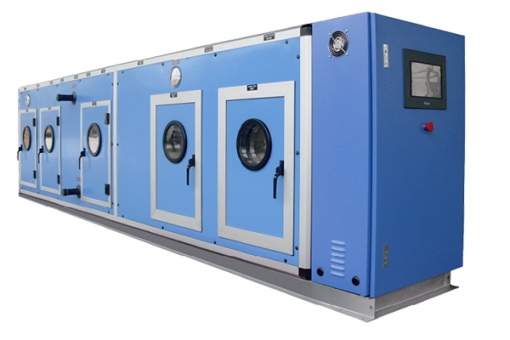
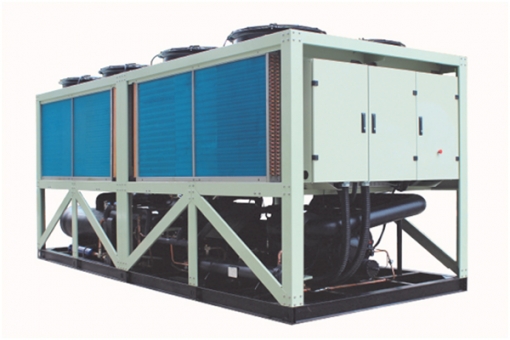
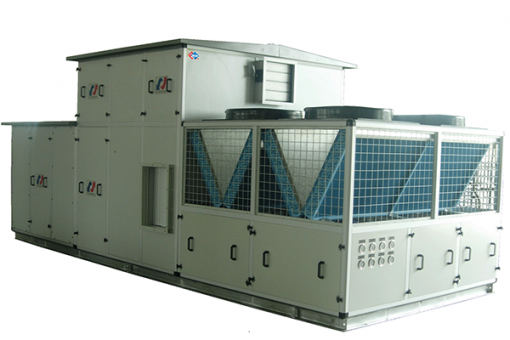
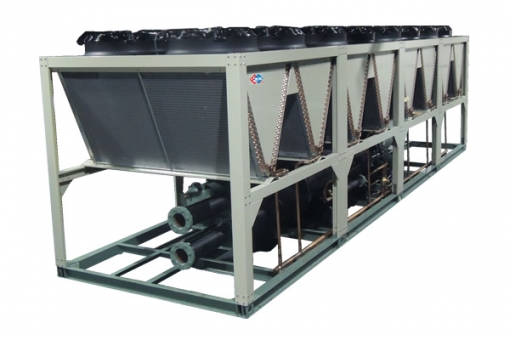
In recent years, an obvious trend has emerged among small and medium-sized shopping malls and commercial complexes: projects with a floor area of around 10,000–50,000 square meters are increasingly choosing air-cooled chillers instead of traditional water-cooled systems.
This choice is not simply a market trend. It is mainly driven by practical factors such as installation conditions, operation requirements, maintenance costs, and actual cooling demand.

Based on years of experience in commercial HVAC projects, H.Stars has found that air-cooled chillers are becoming the preferred solution for many medium-sized commercial buildings because they perfectly match the real needs of these applications.
1. Easier Installation: No Need for Cooling Towers or Dedicated Chiller Rooms
One of the biggest advantages of air-cooled chillers is their simple installation requirements.
Many small and medium-sized shopping malls are built with limited space and often do not have dedicated mechanical rooms reserved for HVAC equipment. Installing a traditional water-cooled system usually requires:
• A dedicated chiller room
• Cooling towers on the rooftop or ground area
• Additional pumps and water treatment systems
• Complex piping installation
These requirements increase construction difficulty, extend project schedules, and raise investment costs.
In contrast, an air-cooled chiller integrates compressors, condensers, expansion valves, and control systems into one unit. No cooling tower or additional cooling water system is required. The equipment can be installed on rooftops, outdoor platforms, or open spaces with simple connections to power and chilled water pipes.
For commercial projects with strict opening schedules, this significantly reduces installation time and construction risks.
2. Lower Maintenance Requirements for Commercial Operations
Many small and medium-sized shopping malls do not have professional HVAC engineers on site. Daily equipment management is often handled by property maintenance teams or general electricians.
Compared with water-cooled systems, air-cooled chillers have simpler operation and maintenance requirements.
Water-cooled chillers require regular:
• Cooling tower cleaning
• Water quality treatment
• Chemical dosing
• Pipe maintenance
• Anti-freezing protection during winter
If maintenance is neglected, scaling, corrosion, and reduced heat transfer efficiency may occur.
Air-cooled chillers mainly rely on air-cooled condensers and chilled water circulation systems. Daily maintenance usually includes:
• Checking operating parameters
• Cleaning air filters
• Inspecting fans and electrical components
This makes operation easier and reduces long-term maintenance costs.
For commercial buildings seeking reliable cooling with fewer maintenance requirements, air-cooled chillers provide a practical advantage.
3. Better Adaptability to Variable Cooling Loads
Shopping mall cooling demand changes significantly throughout the year.
Customer traffic is usually low during weekdays but increases dramatically during weekends, holidays, and promotional events. This creates large fluctuations in cooling loads.
Traditional water-cooled systems often use large-capacity chillers. When operating under partial load conditions, they may suffer from:
• Frequent compressor cycling
• Reduced efficiency
• Excessive energy consumption
Air-cooled chillers, especially modular air-cooled chiller systems, solve this problem through flexible capacity control.
Multiple modules can operate according to actual cooling demand:
• Low demand periods: only one module operates
• Peak demand periods: multiple modules run together
This allows each unit to operate closer to its optimal efficiency range.
For shopping malls with unstable cooling loads, modular air-cooled chillers can provide better energy management and lower operating costs.
4. Is an Air-Cooled Chiller Suitable for Every Shopping Mall?
Although air-cooled chillers offer many advantages, they are not suitable for every application.
For very large commercial complexes exceeding 100,000 square meters, where cooling demand remains high throughout the year, water-cooled chillers may provide better energy efficiency due to their excellent heat rejection performance.
However, for small and medium-sized shopping malls, community commercial centers, and retail buildings, air-cooled chillers often provide the best balance between:
• Initial investment
• Installation speed
• Operating cost
• Maintenance convenience
• System reliability

How Does H.Stars Select the Right Chiller Solution?
HVAC selection is not about choosing the largest capacity or the most expensive equipment.
The best solution should match the building’s:
• Commercial function
• Operating schedule
• Occupancy pattern
• Cooling load characteristics
• Maintenance capability
H.Stars provides customized HVAC solutions based on actual project requirements, helping customers achieve comfortable indoor environments while balancing investment costs and long-term energy savings.
Conclusion
Why do many small and medium-sized shopping malls choose air-cooled chillers?
Because they offer a practical combination of easy installation, simple maintenance, flexible operation, and reliable energy performance.
For commercial projects with limited space and variable cooling demand, air-cooled chillers are often the smarter HVAC choice.
With professional system design and customized configuration, H.Stars helps businesses achieve efficient, stable, and cost-effective cooling solutions.
FAQ 1: Why do shopping malls choose air-cooled chillers for HVAC systems?
Air-cooled chillers are popular for shopping malls because they are easy to install, require less maintenance, and do not need cooling towers or complex water treatment systems. They are especially suitable for small and medium-sized commercial buildings with limited installation space.
FAQ 2: What is the difference between air-cooled and water-cooled chillers?
The main difference is the heat rejection method. Air-cooled chillers use ambient air to release heat, while water-cooled chillers use cooling towers and water circulation systems. Air-cooled chillers are easier to install and maintain, while water-cooled chillers may achieve higher efficiency for large-scale projects with high cooling demand.
FAQ 3: Are modular air-cooled chillers suitable for commercial buildings?
Yes. Modular air-cooled chillers are ideal for commercial buildings with changing cooling loads, such as shopping malls, offices, and retail centers. Multiple modules can operate based on actual demand, providing flexible capacity control, energy savings, and reliable cooling performance.