How to Choose the Right Chiller? 5 Key Factors You Must Consider2026-05-13
Chillers are widely used in industries such as injection molding, chemical processing, printing, automotive manufacturing, food processing, laboratories, and aerospace. Their primary function is to provide stable cooling for equipment and processes. However, choosing the wrong chiller can lead to poor cooling performance—or unnecessary costs. So, how can you select the most suitable chiller for your application?
Why Proper Chiller Selection Matters
An undersized chiller may fail to meet cooling demands, affecting product quality and production efficiency. On the other hand, an oversized unit increases energy consumption and investment costs. In some cases, improper material selection can even make the system unusable in specific environments. Understanding key selection principles is essential for any business.
5 Key Factors for Selecting a Chiller
1. Required Temperature Range
Start by defining your cooling requirements: •What material or process needs cooling? •How quickly must the temperature drop? •What is the target temperature? Standard chillers typically operate within 5°C to 35°C. If your process requires lower temperatures (e.g., -5°C, -10°C, or -20°C), a low-temperature chiller configuration is necessary.
2. Power Supply Requirements
This is especially important for export projects: •Different countries have varying voltage and frequency standards. •Ensure the chiller matches the destination’s electrical specifications. Failure to match power requirements can lead to operational issues or equipment damage.
3. Multi-Unit Operation (Redundancy)
Consider whether multiple chillers are needed: •For critical operations, backup units ensure continuous production. •If one unit fails, others can maintain cooling capacity. This is particularly important for industries requiring high reliability and uptime.
4. Water Flow Rate & Pump Head
Cooling capacity alone is not enough. You must also evaluate: •Water flow rate: Determines how effectively heat is removed. •Pump head: Ensures water circulates properly through the system. Both depend on: •Pipe diameter •Pipeline length •System resistance Proper hydraulic design ensures optimal heat transfer and system efficiency.
5. Explosion-Proof & Special Requirements
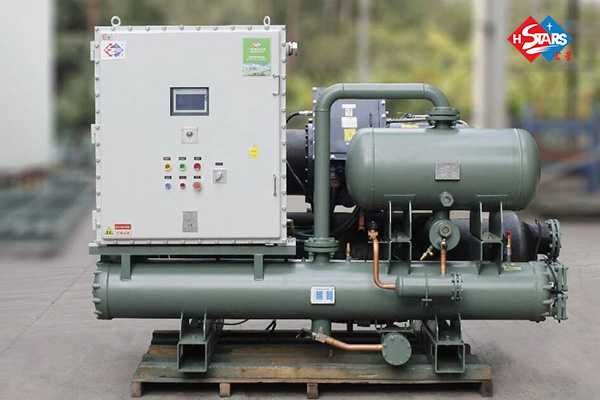
In industries such as: •Petrochemical •Food & beverage •Pharmaceuticals •Coatings and gas processing Safety is critical. Chillers may require: •Explosion-proof (EX) electrical components •Special motors, fans, and control systems The protection level should match the specific operating environment.
Additional Considerations
Beyond the five main factors, you should also evaluate: •Ambient operating conditions •Heat exchange efficiency •Water quality and filtration systems •Tank capacity and circulation design •Material compatibility (corrosion resistance, hygiene requirements)
Conclusion
Selecting the right chiller is not just about cooling capacity—it’s about matching the system to your process, environment, and long-term operational goals. By considering temperature requirements, power supply, redundancy, water system design, and safety standards, you can ensure efficient, reliable, and cost-effective cooling performance.