Why Evaporative Condensing Chillers Save Up to 20% Energy and 80% Water And Why More Industries Are Switching2026-03-04
Principle, Key Features, and Economic Performance of Evaporative Condensing Chillers
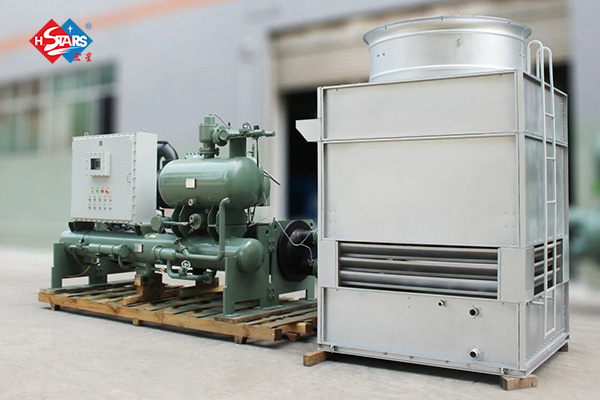
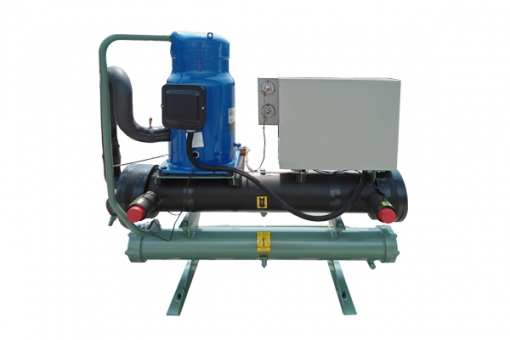
An evaporative condensing chiller is a high-efficiency refrigeration system consisting of a compressor, balance pipe, evaporative condenser, liquid receiver, expansion device, evaporator, electrical control cabinet, and variable frequency drive (VFD). During operation, low-temperature, low-pressure refrigerant vapor exits the evaporator and enters the compressor, where it is compressed into high-temperature, high-pressure gas. The refrigerant then flows into the evaporative condenser, where it releases heat and condenses into subcooled liquid. After passing through a filter and expansion device, the refrigerant is throttled into a low-temperature, low-pressure gas–liquid mixture and returns to the evaporator, completing a continuous and efficient refrigeration cycle.
Why Evaporative Condensing Chillers Perform Better in Challenging Conditions
By integrating evaporative condenser technology with inverter-driven control, evaporative condensing chillers maintain stable condensing pressure and discharge temperature under all-weather operating conditions. This effectively addresses the common challenges faced by traditional cooling systems—such as low efficiency, excessive water drift, and high energy consumption—especially in water-scarce, arid regions or areas with strict energy efficiency requirements. As a result, these systems significantly enhance operational efficiency while minimizing water loss and overall resource consumption.
Energy and Water Efficiency Advantages
Evaporative condensing chillers use evaporative condensers, where cooling water absorbs heat directly from the refrigerant through evaporation. Compared with conventional cooling tower systems, this approach can achieve:
•Approximately 20% energy savings • Up to 80% water savings
By combining the functions of a condenser and cooling tower into a single unit, evaporative condensers require less circulating water, generate minimal drift loss, and reduce pump power consumption.
Working Principle of Evaporative Condensers
An evaporative condenser integrates the condensation and cooling processes that are traditionally separated between a water-cooled condenser and a cooling tower. This design improves conventional cooling methods in two key ways: 1. Eliminates heat transfer between the condenser and cooling tower, allowing direct water reuse and reducing pump energy consumption 2. Shifts heat rejection from sensible heat transfer to latent heat transfer, using water evaporation as the primary means of removing heat
Coil-Type Evaporative Condensers The most widely applied evaporative condenser design is the coil-type evaporative condenser. After heat exchange occurs between the refrigerant inside the coil and the external water film, the water comes into direct contact with high-velocity airflow outside the coil. This simultaneous heat and mass transfer removes water vapor efficiently, maintains unsaturated air conditions, and increases the driving force for heat exchange—resulting in faster heat transfer and higher overall efficiency.
Key Advantages of Evaporative Condenser Applications
1. Exceptional Water Savings
Water consumption is only 1‰–3‰ of the total heat rejection, meaning actual water usage is approximately 5%–15% of that of conventional cooling tower systems, significantly conserving water resources.
2. Superior Heat Transfer Performance
Thanks to the high latent heat of water evaporation, more heat can be absorbed per unit of water, accelerating heat transfer and improving overall system efficiency.
3. Compact Footprint
Evaporative condensers integrate condenser coils, axial fans, circulation pumps, water collection basins, and piping into a single compact unit—ideal for projects with limited installation space.
4. Lower Operating Costs
Reduced water usage eliminates many water treatment requirements associated with cooling tower systems, leading to lower maintenance and operating expenses.
Economic Performance Analysis
Evaporative condensing chillers operate at lower condensing pressures, which reduces compressor power consumption. In addition, they eliminate the need for cooling towers and high-capacity cooling water pumps, further lowering electricity costs. Compared with traditional water-cooled screw chiller systems, evaporative condensing chillers deliver higher energy efficiency and better overall lifecycle economics, making them an increasingly attractive solution for industrial cooling and HVAC applications.